The Low Cost and High Value of Empathy Mapping

When it comes to solving business problems creatively, I always take a customer-centric approach. One of my favorite tools to help get to the core of this is extraordinarily low in cost and impressively high in value and can be performed in a matter of hours. Not days, not weeks, and not years.
It’s called empathy mapping, and here’s why you should care.
Without your customer, you have no business. Empathy is not only unique to our fellow humans but a direct gateway to providing the best possible product or service experience they can have.
There are variations of elements that go into an empathy map, but they typically include:
A clearly defined audience member. These are not marketing personas, so they do not have to be hyper specific. A New Customer may have not heard of your business, but are actively interested in products or services like yours. An Existing Customer is your business’ lifeblood, so understanding them in a holistic way is essential.
What they are saying. This can be needs, wants, or desires.
What they are thinking. This can be challenges or influences.
What they are feeling. This can range from excitement to frustration.
What they are doing. This can be tasks, day-to-day activities, or specific actions.
Bringing all of this together is an “ultimate goal”. This is a single and powerful statement that summarizes a real reason for utilizing a product or service like yours.
The medium doesn’t matter. What matters is project stakeholders actively participate and contribute. Collaborative tools like Figma and Miro work for remote workshops, but absolutely nothing beats conducting this exercise in-person. Regardless of the medium, the greatest success will come from employing a taskmaster who can command stakeholder attention and use creative examples to get them thinking when they feel stuck. Sticky notes, a white board, or easel paper pad will do a great job of tracking elements as you go.
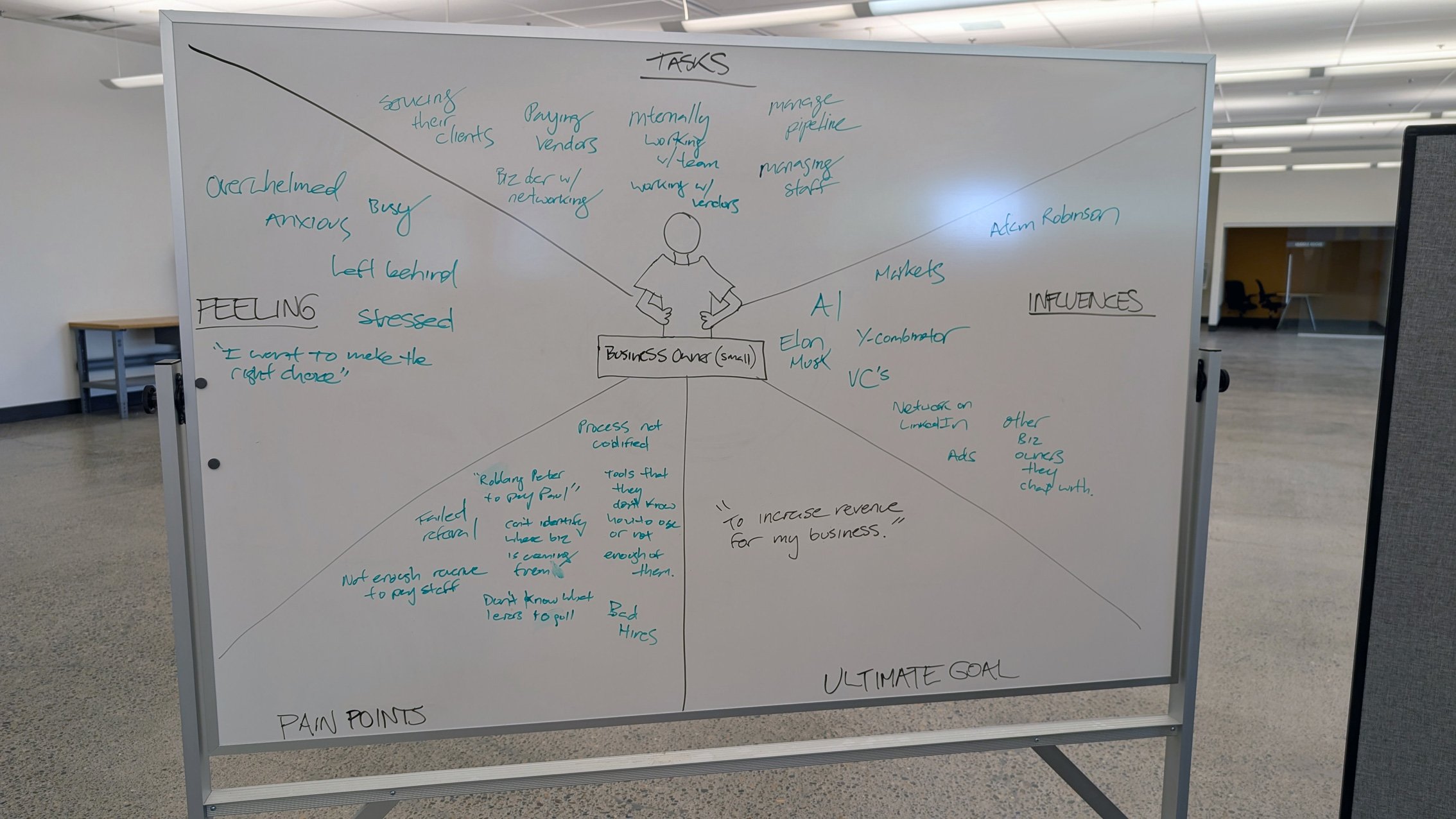
An example of a modified empathy map using variations of typically included elements.
As for the visual format of an empathy map, you don’t have to be an artist, though keeping it light hearted and fun is a good way to keep stakeholders’ attention captive between more serious moments.
As for conducting the exercise itself, here are some thoughts to guide the process:
This exercise can work with just two people (the person conducting the exercise, and you for example), but try to cap it to between 3-6 stakeholders.
Stakeholders should have diversity among their ranks. Optimally one person engages with customers on a day-to-day basis and another never deals with them. You’ll be surprised at what you find with the latter because these people service your customers whether they are visible or not.
Choose and define audiences. New customer, existing customer, etc. You only need 2-3 max.
Start brainstorming and have fun, spending about 15-20 minutes on each audience member.
Coming out of this, the energy and excitement your stakeholders will feel will be palpable. The goal is not just to codify insights, but to get stakeholders outside of their day-to-day and understand what they can do, right now, to deliver an optimal customer experience.
The next level is synthesizing this data and talking to actual audience members. Stay tuned, as there is more to come.
Have questions? Want me to help lead an empathy mapping session remotely or in-person? Don’t wait any longer, reach out today. Let’s work together…